There are more law graduates in Australia each year than the total number of lawyers in Australia.
It may take you years after you graduate to find a job where you practise law.
DIY Law
Not only are there too many law graduates for the job vacancies that are available, you can get advice on how to write your will online. You can file for divorce online. Artificial intelligence delivers instant information that law degrees take years to deliver.
People don’t go to lawyers if they can save themselves money by doing law themselves.
The demand is down. The price is up. There is a glut of law graduates looking for work.
You might think again about doing a law degree.
Law degrees deliver great thinking and analytical skills
If someone with a law degree applied for a job I advertised, chances are they would get an interview. The job probably wouldn’t demand law work but I would presume the applicant could problem solve, think of good wording for contracts and warn me of any dodgy stuff that was in paper work. Someone with a law degree would probably be a good employee.
On the other hand, someone with a business or commerce degree may be better for my business, AND their degree would have cost them half as much.
Make Smart Decisions
If you bought a car for $70,000 you would check out a few car sales places before you made your decision to buy.
All universities in Western Australia deliver law degrees. Pick two or three universities and make an appointment with career advisors. Check out what law degrees you can specialise in. Compare the different courses and support that the different unis deliver…. there is a big difference between the support provided by unis in WA.
Ask current students questions about the courses on Whirlpool.
Curtin and Murdoch then joined the rush for your attention.
Notre Dame keeps being scored as the best university in Australia by its students. You can register your interest in an early offer HERE.
All of the universities are putting in place more requirements that they did last year so students don’t have the freedom to drop out of school once they get offered a place. Each of the universities is slightly different and you can apply for a place at more than one university.
University Career Advisors will get you there
They ALL want you to enrol at their university and are bending over backwards to help you.
– Don’t meet the course pre-requisites? We have a bridging program for you.
– Don’t know how to do referencing? Do this support program.
– Having trouble settling in to uni life? Check out our wellness program.
Pick a university. Is it close? Are your friends going there? Does it have a great course? Do you like its ranking by past students?
– Go to that university and meet with a career advisor. Tell them what you would like to study.
– Ask them what is available to help you to meet entry requirements. They will point you to the best course for you, or design one that meets your needs.
– Repeat at your second choice. Remember you are making a big investment of time and money. You want to check out more than one option.
How to decide
Murdoch has the Horizon Summer Program which introduces you to uni and gives you credits towards a degree. You can do the Horizons Program at the end of Year 11. Email info@murdochinstitute.wa.edu.au for information.
There are many free places in alternative pathway programs but apply early to secure one of them.
What Do Alternative Pathways Give?
Alternative entry programs are from 4 weeks to one semester long and they give much more than academic skills.
You may change your mind about what course to take.
You will find your way around the campus, where to park, where the libraries are.
You find out about uni life and about a range of degrees that are available. You may find out about less expensive ways of achieving your degree.
Although each course is different there are usually 4 subject like….
Academic Writing
Communication Skills
Essential Maths
Research Skills and Information Literacy
Courses like medicine, that have strict quotas, are not available through alternative pathways but most courses will be open to you.
Summary
– You can approach any university or all universities in Western Australia and apply for a place in 2022.
– If your Year 11 ATAR score is good enough your will be offered a place, conditional on how well you do in Year 12.
– If you don’t meet the pre-requisites, or don’t think you will get the ATAR score you need, the university will have a pathway that will help you to get there.
Vanessa Buemi is Program Coordinator of VET and Curriculum at Cyril Jackson Senior Campus (CJSC). Cyril Jackson is one of a growing number of schools in Western Australia that is engaging with community, government and industry to deliver collaborative learning to students.
Towards the end of last year Vanessa invited me to an industry breakfast that recognised support that had been given to their students from outside the school.
Vanessa has kindly allowed me to share her welcome speech which provides insights about their Partnership Model.
Breakfast prepared and presented by Cyril Jackson Hospitality students
Vanessa’s Speech
Good morning and thank you for attending our inaugural Industry Breakfast. I’d like to speak about Partnerships at CJSC and our Partnership Model.
In 2021, CJSC trainers will deliver the following Nationally Accredited Certificates.
Active volunteering
Automotive vocational preparation
Business
Community services
Creative Industries
Engineering pathways
Hospitality
Information digital media and technology 1+2
Music
Visual arts
Technical graphics/CAD
World of Work
CJSC has historically delivered a diverse range of certificate qualifications, across 7 training industries. In the new Covid world, it is more important than ever before to prepare our students to be successful contributors in our ever evolving new world.
New world, new skills
COVID has changed the employment landscape and whilst we were already proving quality training to students we want to make it even better. Our models link students with authentic work and learning opportunities with employers in the same industries they are completing their training.
Teaching and training is enhanced through connections with the world of work and beyond.
Year 11 Plus Program
Our Yr 11 PLUS program has been providing such opportunities for the last 5 years, initially through a Certificate 1 in Work Preparation and later, Certificate 1 in Business. VET in schools, now called VET delivered to secondary students, has enabled students to begin their training whilst still completing their schooling. University pathways once considered the superior pathway to higher studies has not always been the preferred pathway for all students. We all learn differently, and VET and Workplace Learning opportunities have opened the doors for many, many students.
Policy Changes Delivered a Challenge to CJ Programs
In education, the 2016 new WACE requirements of requiring an ATAR or Certificate II qualification as the minimum requirement to achieve WACE, failed to recognise a substantial proportion of students learning needs; students like those who choose to come to Cyril Jackson to learn English.
Certificate I qualifications were largely overlooked as they did not meet minimum requirements for WACE. Certificate I qualifications disappeared from our auspicing choices and the education gap grew once again.
Our 11 PLUS program, often considered a second chance for students who have disengaged from school for many different reasons, including sociology economic and mental health reasons, has been affected by the disappearance of certificate one qualifications on scope for auspicing.
Innovative Solution to Tricky Problem
Finding a certificate II qualification that would be a suitable fit for the overall program and one that would provide new opportunities to thrive was difficult at first….then I found Certificate II in Active Volunteering which was only on scope for delivery in the Eastern States.
I contacted the provider and literally begged them to get it on scope in WA and told them we would be their trial school. That provider is now one of the largest vocational training providers for VET delivered to secondary Schools in WA.
This qualification fits perfectly with the other courses in the program; our Trainer, Teacher and Student Support Officer had the freedom to make academic and practical links with the content of this qualification and SCSA courses such as English, maths and career and enterprise.
This model works!
Links with Industry
It worked with a certificate I and it works with the certificate II in Active Volunteering because of the links with industry that form an essential role in their education at CJSC.
With the removal of certificate I qualifications it is not enough to simply train students and send them out into the world of work. We have to teach them how to transition from school to work or post school training.
Active Volunteering is a powerful qualification, one that allows students to work with members of the community as mentors and friends for others in need. It has been the foundation of personal and academic growth for once disengaged students, who have applied their learning in a safe and supportive environment.
How Cyril Jackson has met Challenges
Some of our students at CJSC start their schooling in our Intensive English Centre. Some have limited schooling and our classrooms may be their first opportunities to have an education. Our dedicated staff support our students in their transition from the Intensive English Centre (IEC) into mainstream, where they begin their Year 11 and 12 studies.
When I first started at CJSC in 2016 I sought to understand more about how the IEC worked and how I could best serve the students in my role as VET Coordinator. In just three years, through working with Belinda and the student services IEC and mainstream teams, we have trialled several successful models to ensure our students next transition into employment or further training is suitably supported. We have done this through dedicated Foundation English and workplace learning classes, building links with written and spoken communication in both a school and work environment.
The health industry, specifically aged care, has always been a strong career choice for some of our IEC graduates and we have worked hard to bridge the gap for our English as Second Language or Dialect, or EAL/D students, whose written and spoken English is still developing. Opportunities for our students to gain places in funded courses can be competitive and this has often meant these students have to wait until they complete Year 12 before can begin their vocational training.
Partnership with North Metro
In 2019 we entered into a partnership with North Metro TAFE establishing a dedicated EAL/D class of CJSC students to begin their VET delivered to secondary students training whilst also completing their courses at CJSC.
All 13 students graduated in June 2020 amidst the unpredictable early days of Covid interruptions to education and face to face classes.
These students have recently completed Yr 12 and this cohort meets again on Thursday to begin their higher studies in the health industry, through our new partnership with Amana Living.
Going Beyond the Campus
What makes both of these models work is the CJSC approach to supporting students, not only in the classroom but also through community work placements that allow our students to apply their skills through authentic learning opportunities. We aim to develop further partnerships such as these.
Every single staff member is invested in these students
Our students are supported by our team of teachers, trainers, workplace learning coordinator, IEC teachers and education assistants, our student services team, Deputy Principals and our remarkable Principal, Dr Karen Read.
They are our future and we are incredibly proud of our programs, team approach and most importantly our students who value education as a privilege.
You will not find a more dedicated school community and students with a phenomenal work ethic and will to succeed.
Our current partnerships include;
Aegis Bassendean
Amana Living,
DADAA
Ertech,
Garden City Plastics,
Plantrite
Black Swan State Theatre
WA Youth Theatre Company
Leeuwin Ocean Adventure Foundation, and
the Cities of Bassendean and Stirling.
We hope to work with you in 2021, building strong working relationships in support of our future workforce.
Editors Note:
Thanks Vanessa and staff at Cyril Jackson. Our hearts burst with appreciation for the wonderful work you are all doing. As one student spoke I choked up and reached for a tissue, I glanced around to see EVERYONE at our table was in the same boat!!
Vanessa Buemi
At the end of the morning there were hugs and congratulations all round.
Vanessa has already offered to support teachers at Balcatta SHS by sharing details of how CJ has generated such a great environment for its students. I am sure she would be happy to pass on her wisdom to others.
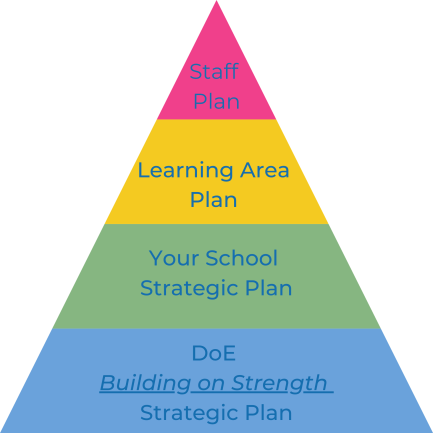
Most teachers and many school leaders have never been taught how to do strategic planning. This quick guide to strategic planning could help you to achieve your professional goals. My interest is in promoting career education but you can use the process on any subject area.
Strategic planning is about clearly identifying what you want to do and how your are going to do it.
If you work for DoE, the priorities have already been set for you in the Building on Strengths document.
Schools use those priorities to identify their own strategic plans.
Each learning area will then create a plan based on those school strategic plans.
Each staff member will develop their personal plan based on their learning area plan.
DoE Priorities
Provide every student with a pathway to a successful future
Strengthen support for teaching and learning excellence in every classroom.
Build the capability of our principals, our teachers and our allied professionals.
Support increased school autonomy within a connected and unified public school system.
Partner with families, communities and agencies to support the educational engagement of every student.
Use evidence to drive decision-making at all levels of the system.
Career Education Learning Area Strategic Plan – based on DoE and School Priorities
Your school will identify local strategies against each of the 6 DoE priorities.
There are the 3 priorities for career educators to focus on. Check out your school plan. See what strategies you can add.
DoE Priorities
Career Education Strategies aligned with school KPIs
Provide Every Student with a pathway to a successful future
This is the big one for career educators. Building on Strengths talks about career skills in this priority.
If you have a reference or advisory group you could do a SWOT and USED analysis with them to identify key strategies.
– Check back copies of the In Focus Careers newsletter for ideas against STEM, Aboriginal priorities, future work directions and skills, entrepreneurial projects. – Look for advice from the DoE career education leaders and to CEAWA – Use Job JumpStart resources to build employability skills. – Work experience would go in here. – Check the Magic Happens Handbook for ideas
Strengthen support for teaching and learning excellence in every classroom
This priority doesn’t specifically mention careers but you can support this strategy by: – directing teachers to jobs in their subject area – establishing a career hub in the library – putting information about events from the In Focus Careers newsletterinto school notices – creating career notices for each learning area each month. – developing a database of subject area career experts that teachers can call on
Partner with families, communities and agencies to support the educational engagement of every student
This is a priority where career educators can shine. – Check out the Future Jobs, Future Skills STEM strategy to see who you can work with and opportunities that are available. – Your school’s Parents and Friends Association and past students are a great source of support as speakers, work experience providers and mentors. – Opportunities to engage with people outside school are identified every month in the monthly In Focus Careers Newsletter. – Establish partnerships and MoUs with local governments, businesses, organisations like WITWA and get them to support your students.
The next step is to put your strategies into a project plan. You can find a project planning proforma here. The Medium Project Business Plan is probably the best one for a project of this size.
Strategic Planning Help
Your school can delight families, achieve better educational outcomes and become a leader in 21st century education through the design and delivery of a well designed strategic plan.
In Focus Careers can:
Analyse your school strategic plan against system wide plans and report on what is going well and where there could be improvements.
Run strategic planning workshops.
Run professional development for staff on how to do strategic planning
Draft a strategic plan for your school.
Create a business plan based on your strategic plan.
Design a performance management template for staff to use as they plan their activities against the school plan.
Ensure that career education is a key consideration in your school planning.
In most cases the links are through to the information provided by the Good Universities Guide Career Ladders. Where information wasn’t available on the Careers Ladders I have added a link to the most useful information I could find.
The Good Universities Guide has uni and VET courses
MyFuture
MyFuture has videos and great information about careers. It may be worth subscribing as all States and Territories contribute to that central store of information. It costs about $15 a year to subscribe.
MyFuture was created by all Australian States and Territories. It is THE most comprehensive career site we have.
In Focus Careers
I wrote a post recently with updated links to all of the key careers sites.
Getting into medicine is a job. The competition is fierce and the pathway is rigorous. Many potential doctors fall by the wayside due to the strain of the application process.
During the summer holidays 30 students who were going into year 11 and 12 this year did a week long, hands on and theory course at the Harry Perkins Centre. The program is run by Scitech to help students to find out more about health careers in WA.
The School Curriculum and Standards Authority (SCASA) is THE mob that makes up the rules about WACE. The first place to find information about Year 11 and 12 is in the official Year 10 Information Handbook which SCASA puts out.
If you can’t find the information you need or if you are unclear on anything contact them at info@scsa.wa.edu.au.
STEP 2 Hear Your Dream
You need to have some idea about what career direction you would like to take.
Many schools have the Career Voyage program that will help you to nail down a career direction for the near future. If you don’t have access to Career Voyage at school you can do the quiz at a Jobs and Skills Centre.
I have done this Coggle brain storm of a bunch of places you can check out to narrow down what you like.
Email me Bev.J@infocus-careers.com.au if you would like access to the Coggle map so that you can just click on the links.
STEP 3 Do You Want to do ATAR??
For years ATAR results were the short cut that universities used to choose their students. Things are changing. Competition between universities has heated up and they are looking at many alternative pathways that:
enable more students to go to university
ensure students don’t fail when they get there.
Universities are looking for alternative pathways more than schools and parents.
TAFE has always been flexible with its pathways to learning than universities and there is a huge range of possible pathways offered.
Job Prospects for Young Job Seekers
Last year the Career Development Association put on a webinar delivered by Ivan Neville, from the Commonwealth Department of Employment. He said….you really need to get a year 12 qualification, or equivalent, to get a job…..
But there isn’t much difference in employment outcomes between a degree (3.6%) and a Cert III (4.1%).
The opening of university entry to a wider audience had resulted in a shift towards degrees and away from vocational education since 2008.
There are now stronger job outcomes for apprentices and trainees than people with degrees.
Step 4 Check Course PRE-REQUISITES
There are lots of courses that have RECOMMENDED subjects, but not so many have definite PRE-REQUISITES that MUST be done as a WACE subject in order to get into a course.
There are lots of pathways into further study and your WACE pathway is just one of them.
The most direct pathway is however, to take subjects that the universities are looking for. So, once you have narrowed down a career direction to take, check out the TISC University Admissions Handbook. It identifies what WACE subjects you should take to keep your options open.
OLNA
The Online Literacy and Numeracy Assessment (OLNA) is the minimum WACE requirement reading, writing and numeracy. It is usually done in 10 but there are more opportunities to sit the Assessment in Year 11 and 12 and even AFTER Year 12.
Prospective TAFE students who do not meet these standards can:
sit a TAFE Admissions literacy and/or numeracy test administered by Training Sector Services;
be referred to a TAFE college for a Learning Area Assessment; or
enrol in a course that does not have literacy or numeracy requirements, including foundation skills, equity courses and Certificate I
Step 5 Contact Your Career Advisor
Tap into the knowledge and experience of your career advisor.
If you don’t have access to a specialist career advisor at your school, go to a TAFE college Jobs and Skills Centre or private careers consultant to be sure your next step is the right one.
For your monthly dose of inspiration and insanely great career information subscribe to my newsletter:
I have found your material invaluable. The information you have put together is thorough – a one-stop-shop in a sea of information that is out there. I have utilised this information on a regular basis with others throughout the school.
(South Metropolitan Government High School.)
My Commitment to West Australian Careers Education
For In Focus Careers to be the conduit to Insanely Great Careers Information for West Australian students I undertake to:
Write 10 insanely great issues of In Focus Careers newsletter each year that focus on the needs of West Australian students and careers teachers.
Search for local, national and international information that could impact on the careers of West Australian students.
Connect you with insanely great careers teachers across the In Focus Careers network.
Listen to and support West Australian careers teachers.
Curtin Medical School offers the only West Australian Bachelor of Medicine Bachelor of Surgery program that students can enter directly from school. Both UWA and Notre Dame offer medicine courses but they require applicants to have done a degree as part of the application process.
(Go HERE for information about UWA Direct Pathway program.)
Curtin’s Focus
Curtin is focusing on providing medical services in rural, regional and remote (RRR) Western Australia so are using their Curtin’s Step Up criteria to help RRR applicants and students from outer metropolitan schools to apply. This Set Up list will be finalised for 2019 in July. You may qualify for an Equity Bonus even if your school isn’t on the list so keep an eye on the Curtin updates.
You can only get 5 bonus points even if you qualify on the Set Up list and for the Equity Bonus.
They are aiming to have 25% of students from RRR areas.
The Curtin course is only in its second year and there were 1511 applicants for the 70 places offered this year so even with the additional support it is a very competitive program to get into.
Most of the places were given to school leavers and only 6 places were given to course switchers or mature age students.
There will be 80 places in 2019.
Applying for Medicine at Curtin
Use the normal TISC process to apply.
Curtin is providing support to enable Aboriginal students to gain a place. Aboriginal students should apply through the Aboriginal Studies Indigenous Pathway.
Course Length
The Curtin Degree is 5 years long after which students do a an 47 week internship before becoming a doctor.
Studying medicine is just your first step in your medical academic career. After completing your internship you will take on further study to be a GP, surgeon, obstetrician or some other specialisation.
While most university courses have short academic contact years, the Curtin Medical School requires students to have 40+ contact weeks.
ATAR Requirements
Applicants must have a minimum ATAR of 95. The lowest ATAR score for 2018 was 96.15.
RRR students who can show they are eligible according to Curtin criteria will get 5 bonus points added to their ATAR score.
Chemistry is an essential prerequisite for applicants.
Human biology is not a prerequisite as it is taught in first year, however those students who have already done human biol at school will find it easier to get good grades in this subject at uni.
Applicants who pass the UMAT must provide a predicted ATAR score from their school on the form that Curtin provides before the end of November so that Curtin can use that mark to shortlist applicants for interviews.
The ATAR is worth 40% of the application score.
UMAT Requirements
Students must undertake the UMAT exam and score at least 50 in each of the 3 exams.
There are practice UMAT tests on the site and students need to do those in order to know what to expect.
There are private training organisations that provide UMAT coaching. ACER, which runs the UMAT says not to bother. Some students do…. You need to make up your own mind about whether to do the additional coaching or not.
The UMAT is held on 25 July. You must apply by 1 June.
TIP: If you have put Medicine at Curtin as your first TISC preference and you don’t achieve the requirements in the UMAT, change your preference with TISC. You can do that after the closing date by paying a fee.
The UMAT is worth 20% of the application score.
Multiple Mini Interviews (MMIs)
These sound like torture.
All applicants who are shortlisted based on their ATAR and UMAT results are invited to undertake interviews.
That sounds harmless enough….
The MMIs are 8 consecutive interviews of 10 minutes each.
Students go to a room.
There is a scenario written on a page on the door of the room.
You have 2 minutes to read the scenario.
You are invited into the room and you have 8 minutes to talk about the scenario.
You leave and go to the next room.
Repeat.
This routine can vary slightly from year to year. Last year they were 6 minute interviews. Again, Curtin will let you know the drill if you qualify for an interview.
For the 2018 intake there were 350 interviews offered. As many of the applicants were from the eastern states and got offers from their local universities, 200 undertook interviews at Curtin.
YouTube videos and sites like MedStudents Online and Whirlpool will give you some ideas about what to expect BUT your experienced interviewers are not looking for rehearsed answers, they want to know about you and your suitability for the profession.
The MMIs are worth 40% of your application.
Teaching and Learning Approach
Curtin takes a problem based learning and evidence based teaching approach that is supported by clinical skills tutorials. Students learn to work as part of health care teams by problem solving in consultation with students in other health care courses.
Once students have developed skills in a classroom setting they take up full time placement in hospitals.
The academic demands of the course are high. Students need to be resilient to cope with the study demands and they need to be resilient to deal with the adversity that often faces doctors.
Check out the Inherent Requirements of Curtin Medical students to see the sort of attributes they are looking for in the interview.
Presentation Video
You can watch a video of the Curtin Getting Into Medicine presentation HERE.
More Information
If you have any further questions about studying medicine at Curtin, please give the Future Students team a call on 1300 222 888.
You can find other blog posts about getting into medicine at:
The path to medicine is the starting point in your career.
You can choose to do any course for the undergraduate degree which is a prerequisite for medicine at UWA, Notre Dame and many other Australian universities.
To increase the range of undergraduate degrees that you can take make sure you take English (or English Lit), Chemistry and Physics (or Human Biol) as ATAR subjects.
If you are interested in medicine it follows that you might be interested in a health science course for you first degree.
Some speakers had chosen to specialise by doing a PhD, some were doing research in hospitals, while others had gone into management or were working on international committees.
One had used his science PhD as a pathway to found Exodus Space Systems which is developing systems for settling the solar system!!
There were presentations on biomedical science and biomedical engineering with some exciting and crazy talk about mechatronics and 3D printing of organs. The future for engineers in the health industries is changing at a dizzying pace.
Speakers in the various presentations across the Open Day made a few key points:
Go Broad
In order to get a broad understanding of the health industry speakers recommended that you choose a broad range of subjects in your first year which maximise your choices for specialisation. They suggested that you maximise your flexibility through a strong focus on maths and sciences that give depth as well as breadth.
Communication Skills
One of the key underpinning skills mentioned by one speaker was the development of strong communication skills. She said that her capacity to formulate a reasoned argument quickly was a direct outcome of her science degree.
The need for communications skills was reinforced by others who mentioned the need to negotiate for clinical or resource priorities as well as the need to explain your decisions to patients, politicians and the public.
The message was that good communication skills would be your gateway to a range of opportunities across many industries. They said that is was easy to turn a health scientist with good communication skills into a business person in many interesting fields.
Network
It is possible to do your degree online, from the comfort of your own home.
Don’t do this.
Uni life can be so much more than study. Use the campus. Join social clubs. Go on camps. Do sport. Through these opportunities you can make lifelong friendships.
A self proclaimed introvert on one of the panels said it took her significant effort to force herself out of her home and onto the bus to the campus so that she could meet and mix with people.
In addition to networking with other students it was advised that students take opportunities to volunteer and get experience through contacts at the university. All of the speakers had stories about how they had been encouraged to apply for scholarships, or present papers at conferences or had found part time jobs which led to other jobs.
Finally
This was a day of UWA selling its health science courses… and they did it well. It seemed that a strong, broad health science degree was your gateway to a million opportunities.
People on the panel didn’t know where their careers would take them and all praised UWA for providing the first step on the heath industry career.
If you are serious about a career in medicine you should also check out the range of undergraduate courses at West Australian universities:
There are lots of doors that can lead to a university degree and if you have had one gap year (travelling, working, watching Netflix) it is even easier to go through those doors at some universities.
The alternative pathways are FREE at all universities although quotas have been introduced so numbers are restricted. The government is trying to introduce fees for these pathways and universities are protesting about that so they are largely free at the moment.
Portfolio Entry (Experienced Based Entry)
This pathway is available at a number of WA universities. Demonstrated proof of your abilities via a portfolio of evidence of your academic achievements and abilities, or demonstrated proof of your ability. Portfolio entry is not just restricted to the creative arts.
Curtin University
Step UP – You may be eligible for Step Up if you meet socio-economic or educational disadvantage criteria. If you are eligible and got an ATAR Score between 60 and 69.95 Curtin will automatically bumped up to 70 which is Curtin’s minimum ATAR requirement.
StepUp Bonus – this depends on the applicant’s eligibility, however this gives them an extra 5 bonus points if their ATAR is above 70.
Portfolio Entry – is not only for the creative courses; it is applicable to courses like Education, Science, Commerce and Health.
Uni Ready Enabling Program – this program is designed to help you gain entry into a range of Health Sciences, Humanities or Curtin Business School undergraduate courses. In terms of the age limit, applicants must be past the compulsory school age (generally that’s about 17 years old).
Enabling Course in Science, Engineering and Health – this course also has the same age limit as UniReady. Depending on their course weighted average, completion of this program will meet relatively higher entry requirements and subject prerequisites, too.
Curtin College offers courses that can result in entry to second year of Curtin’s Bachelor degree program.
Thanks for the update from: Christine Lim Future Student Advisor | Curtin University
Murdoch University
On Track – a 14 week course that prepares students for entry to a course with a minimum ATAR requirement of 70.
On Track Sprint – a 4 week course run over the Christmas holidays that may prepare you for entry to a course with a minimum ATAR requirement of 70 or less.
TLC10 – prepares students to apply for Murdoch through a 1 day per week course that runs all year in Mandurah and Rockingham.
Portfolio Entry – you can gain entry to courses that rely on creative talent in media, games art and design and creative writing, photography and web communication via a portfolio demonstrating your work + a number of hoops like WACE and English competence. For Portfolio entry try the Domestic Admissions Team on 9360 7458 or send an email by following this link
ECU Access- Eligible students from identified Western Australian schools will receive an automated ATAR adjustment of up to 10 selection ranks to support the entry of students from areas with educational disadvantage:
Eligible students with an ATAR of 60 to 69.95 will receive a selection rank adjustment to 70; and
Eligible students with an ATAR of 70 and above will receive a selection rank adjustment of 5 to a maximum ATAR of 90.
If your school is listed here and you need to find out more, please talk to your school careers adviser or contact the ECU Student Recruitment team on 134 328.
Portfolio Entry— ECU offers the largest choice of course entry via portfolio. You need to provide an introductory letter, resume, academic records and references.
Edith Cowan College– Offers courses that can result in entry to second year of ECU’s Bachelor degree program
UWAY – This is an alternative entry pathway and comprehensive support program for students completing Year 12 under challenging circumstances. The program provides academic, financial and personal support, and it is responsive to individual student needs, throughout their final year of secondary school and during their university studies. You can apply for alternative entry to an undergraduate degree course through UWay if your academic achievements have been adversely affected by certain disadvantages.
Broadway – This scheme allows eligible students from a Broadway-identified Western Australian school to receive an automated ATAR adjustment for their application to UWA.
The Mature Age Access Program allows a mature-aged student with little or no previous background in tertiary study to begin studying under a provisional enrolment without having to meet the standard entry requirements. Using this program mature-aged students have the opportunity to meet academic and English prerequisites for entry while beginning their course.
Thanks Philip Sharpe, Future Students Centre, University of Western Australia
Students complete a one-week Learning for University intensive course during Orientation Week. This course is designed to facilitate your transition into university life and must be successfully completed before you progress to the remaining four courses:
This program is tailored to help you meet entry requirements or boost your confidence. It usually takes between 1 and 2 terms to complete (4 to 8 months). It can be completed online or on-campus.
The STEP course is FREE.
TEP (Tertiary Enabling Program) is an enabling course designed to cater to students of Aboriginal or Torres Strait Islander heritage.
Thanks to Sandra Emanuel CQU Marketing Coordinator for the update.
Aboriginal and Torres Strait Islander Entry Pathways
All Western Australian universities and TAFE colleges have Indigenous Entry Programs and specialised support to help students to succeed in their studies.
Vocational Education and Training Pathway
Start your degree at TAFE and finish at university.
TAFE frequently has smaller classes and more practical learning than universities.
TAFE courses often provide credit points towards degrees. Check your local college for specific courses details. You can arrange an appointment with a college based career advisor to find out what courses you can take and what credits they will give to university.











 Many schools have the Career Voyage program that will help you to nail down a career direction for the near future. If you don’t have access to Career Voyage at school you can do the quiz at a


 Curtin is focusing on providing medical services in rural, regional and remote (RRR) Western Australia so are using their
 Students must undertake the
 If you would like a presentation on Getting Into Medicine at your school contact me at


 There are lots of doors that can lead to a university degree and if you have had one gap year (travelling, working, watching Netflix) it is even easier to go through those doors at some universities.
 On Track
 ECU Access-
 UWAY
UWAY
 All Western Australian universities and TAFE colleges have Indigenous Entry Programs and specialised support to help students to succeed in their studies.
 Start your degree at TAFE and finish at university.