Posted on — Leave a comment

The Olympics are coming. Want a career in sport?

The Olympics are coming. The Australian team is being selected. The Matilda’s are in the top 10.

So many students play sport. So many would love a career in sports.

Being as part of a team gives you a shared purpose, a feeling of belonging and goal to strive for.

If you want to work in the sport you love, there are hundreds of opportunities.

Sport Super Stars

You know who you are. You have natural talent. You have enormous capacity to endure hardship and you have trained your skills to perfection. You are going for GOLD.

Through your weekly engagements you will be noticed. You need a trusted, wise mentor and coach, who is dedicated to your success and who knows how to guide you through the politics of elite sport.

What to do now

You can find a heap of information about careers as a sports person at the Future Now Industry Training Council.

Supporters of Major Sports

This is where the jobs are. There is an army of supporters who create the world of sports in Australia.

Download a copy of Careers in Sport and Recreation for information.

What to do now

  • Check out the range of jobs associated with sport HERE.
  • Check out some of the funding that is available to support your sport.
  • Apply for a part time job associated with you chosen sport.
  • Volunteer to coach junior teams.
  • Start a blog or newsletter covering your games, training sessions and stories about different players.

MyFuture Careers in Sport and Recreation

The Australian Careers site MyFuture has this roundup of jobs and careers in sport and recreation.

Subscribe to In Focus Careers News

Subscribe to In Focus Careers for all the information you need about careers for West Australian school students. 

Posted on — Leave a comment

Career Exploration Toolkit: Navigating Your Path to Success

The Career Expo is like the Royal Show. There is so much to see and do that you can miss something you love by not knowing where to look.

I have done three worksheets for schools which families might find useful to check out.

Step 1: Pre Expo Preparation

This is the most important step. Without at least some preparation the visit can become a race through and you could miss information that could change your life!!.

Download the Worksheet HERE.

Step 2 What to do At the Expo

  1. Get a copy of the Expo map so that you can find your chosen Exhibitors.
  2. Go around the Expo with your Buddy.
  3. Collect handouts from each of your identified exhibitors and talk with the experts. Your Buddy supports you with follow upquestions.
  4. Take photos of things of interest for your class presentation.
  5. Check out anyother exhibits that interest you

Download the worksheet HERE.

Step 3 Post Expo Presentation

This stage is really just for schools and teachers. It ensures students can reflect on their Expo experience and identify what steps they are going to take based on what they learned.

DOWNLOAD THE WORKSHEET HERE.

In Focus Careers provides current career news and tips for West Australian high school students.

Subscribe HERE.

Posted on — 6 Comments

Year 11: A Step by Step Guide to Open Days

Going to open days helps you to discover:

  • How to get to the campus.

  • How long it takes to get there.

  • Where the Open Day takes place.

  • Where to find food vans, toilets, and library.

  • Where to find different exhibitions and lecture theatres. 

  • Where to find student accommodation

  • How to read the presentation and demonstration schedule.

Get an authentic experience 

Plan to go with a friend

Ask your friends to go with you and your family. What they are interested in? Make sure you know what they might want to explore. Make a commitment to support each other on the open day.

Your parents. will have the biggest influencers on your career choices, but your friends are great to bounce ideas off. They will give you views of someone your age. 

Check

Check the university open day web page with your parents and friends to find details about any special courses that you want to investigate or talks you want to attend. 

You may need to change the time you attend to see a presentation that is of interest to your career choice. 

On the Day

Find out how uni works

Each degree is made up of subjects (units) for which you get points. (Check First in Family site)

  • Ask how many years it will normally take as a full-time student to get enough points for a degree.

  • Ask about subject choices for each of the courses you are interested in.

There will be handouts. 

Ask about scholarships 

There are many scholarships you can apply for. Ask the careers staff to give you a full breakdown of scholarships that could match your profile. 

If you are interested in staying in uni accommodation, ask what financial support is available. 

Clubs 

There are a million clubs that you can join at university. You have more than a year to make choices so check out a few.  You can join some clubs while still at school.

Book an appointment with a career counsellor

These appointments are free and it is the job of the career counsellor to help students.

If you get this help in Year 11, you will be more settled throughout the rest of the year and through Year 12 because you will have a stronger idea about what you want to do when you leave school. 

Entry Requirements

While you are checking out the courses ask about prerequisites and recommended courses that you should take before applying for particular courses. You also need to know the required ATAR score and alternative pathways to uni. 

Get your copy of Study Coach: Save time. Get better results.

Subscribe to In Focus Careers News

Subscribe to In Focus Careers for all the information you need about careers for West Australian school students. 

Posted on — Leave a comment

Unlock the Potential of Career Education in just 10 Hours a Year.

Despite mountains of research showing the value of career education, career advisors struggle for resources, time and recognition.

Don’t try to face these challenges alone. In 10 hours per year, you can get the support of a dynamic group of local industry representatives who will transform how career education is recognised in the school.

This will be the group you go to for advice and support. They will be the first ones you go to for guest speakers, work experience, mentoring, expos and industry tours. They will have networks to support your goals.

Example

Vet Nursing Advisory Board for South Metro TAFE

At one stage in my career at TAFE I was put in charge of Veterinary Nursing. I knew nothing about it so set up an industry advisory board with members from the Australian Veterinary Association, The Vet Surgeons Board, Vet Nurses, industry groups – from agriculture, racing and gaming and a student representative.

They delivered information, advice and support to the students and enhanced the work we did by aligning it more to industry needs. They provided industry connections for work experience, and recommended us to pet food companies that donated food for animals in our clinic.

Your Guide

Hour 1: Get the support of your principal

Put a pitch together about how an Industry Advisory Group will enhance the career education of students. The Principal may want to know details which I have put in “Hour 2”.

Hour 2: Thinking Time

Decide roughly who you want on the group:

  • Someone from a Jobs and Skills Centre
  • A member of the local Rotary Group (great for mock job interviews, work experience and mentors).
  • A member of the local Chamber of Commerce and Industry.
  • Someone from retail (Coles/Woolworths/ Bunnings/McDonalds)
  • Someone from an aged care facility.
  • You could try the Construction Futures Centre, or a trade group in your area.
  • Someone powerful who is willing to help – in my area we have Hofmann Engineering, they are a multinational company and they so generous with their time and support.

Decide how often you will meet. Probably twice a year for an hour.

Decide what will happen to their ideas. Maybe the minutes of the meetings are sent to the school management and school board and they will guide your work. Say you will report back on progress at each meeting.

Set a date and time for the meeting at the school. Book a room.

Hour 3 and 4: Busy Work

Ring people. Invite them to be a member of the (name of school) Industry Advisory Group that aims to build the capacity of career education within the school.

Follow up with an email invitation to the first meeting.

Hour 5: Hold the Meeting

Make sure you have tea and coffee and a biscuit for them.

You are a teacher. You KNOW how to facilitate a brilliant meeting.

You might want to:

  • Welcome and introduce the purpose of the group.
  • Do some brainstorming with the group through a SWOT analysis.
  • I like to analyse to SWOT to get ideas for how to Use each of the Strengths, Stop the Weaknesses, Exploit the Opportunities and Deny the Threats. That gives me a “to do list”.
  • Tell them you will write up the notes from the brainstorming and send them out to them.
  • Set a time for the next meeting.

Build relationships. Have a cup of tea/coffee and a talk.

Hour 6 – 7: Write up the notes and distribute

After the meeting write up what happened in a report send it to everyone.

Talk about it at staff meetings. Put it into your school newsletter. Let the District Office know. Let me know and I now and I will put it in the next In Focus Careers newsletter.

You will be able to call on your Group members to support any of the initiatives you want to launch at school.

Hour 8: After 6 months write a Progress Report

After 6 months write up a basic Progress Report for your next meeting and email it to everyone in the group.

Include the time and place for next meeting.

Hour 9: Prepare for Next Meeting

Book a room. Get tea and coffee. Prepare the agenda. Would your principal want to come?

Hour 10 Hold Next Meeting.

Report on and discuss progress and note further suggestions.

Repeat 3- 10 above for next year.

You are on your way

Your Industry Advisory Group will be your greatest asset. They provide work experience, mentors, guest speakers, expo displays and industry advice AND they can be a powerful voice that trailblazes the way for career education in your school.

It really is worth setting aside 10 hours per year to put in place infrastructure that will make your life easier.

Posted on — Leave a comment

What is a Skills Passport and why do you need one?

A Skills Passport is an online record of all your qualifications and skills.

The government is about to initiate consultations with employer groups, unions and educators aimed at identifying the advantages of creating a National Skills Passport. This initiative would consolidate all your qualifications and skills into a single, user-friendly database.

You need one because..

  • It might significantly ease your transition from one employer to another.
  • Many people may not realize that completing certain courses, such as a White Card or a barista course during school, actually grants them formal qualifications.
  • It’s possible to inadvertently overlook a job opportunity if you forget about a customer service qualification earned during your initial employment at McDonald’s or Bunnings.
  • As you progress through life, continuous learning is inevitable. Without a comprehensive database to store your course history, it’s easy to forget what courses you completed a decade ago.

What does it do?

  • It consolidates all your qualifications into a single database.
  • It will be integrated with standardized criteria, ensuring that certifications from”Dodgy Brothers Training” are not seen as the same as those from TAFE colleges or universities.
  • The system will adhere to interoperability standards, guaranteeing that all qualifications are recorded using a uniform format, which will allow seamless sharing and compatibility.

Why I won’t use it…

  • I used to work with IT security specialists and I am cautious about sharing personal information.
  • Identify theft is easier when everything is in one place.
  • I don’t trust that the information would not be used for different purposes.
  • I can keep my own records of my qualifications.
  • If they let me know what standards and format they want in a database, I will create my own sharable database that I will manage.

Make up your own mind

If you are a teacher or career advisor, you may want to use it to make sure school leavers have a record of all qualifications they have achieved. In that case a Skills Passport may be a convenient solution.

There will probably be an opt out clause that will allow users to stop using the service.

I think a Skills Passport could be a cool solution to people not taking responsibility for keeping their own records.

Posted on — Leave a comment

Can you wash up your coffee cup? The Generation Gap in the workplace

Have you asked a new graduate to wash their coffee cup?

Have you asked them to leave their classroom neat and ready for the next teacher?

According to some experienced teachers, asking this could risk complaints about bullying.

Work Readiness courses

There are currently 6% of Gen Zers in the paid employment and that per centage is growing, while baby boomers remain at around 20%. The generation gap between 20 year olds and 60 year olds is causing both young and old workers to resign.

Ten years ago “work preparation” courses taught uni graduates that they were not the bosses and to do the work as they were asked, without being “creative”.

Perhaps that would help, but it is not enough.

What can older workers do?

Older workers often think we know it all.

We don’t.

Dave Turner, career guru, from South Australia, says saying “hello” and asking about their weekend will make young workers feel more accepted.

He encourages employers to engage more with their local schools to:

  • gain a realistic idea of school students
  • prepare students for the workplace

Zoomers, our youngest employees

Danielle Kabilio, is building a reputation as an expert in this field.

She recently spoke on the topic to a Food Fibre and Timber Industry Training Council seminar for employees who are struggling to retain younger workers.

She is speaking on the topic at the CDAA Good Theory, Good Practice conference on 23 September. Teachers , private practitioners and HR experts are all interested in how to address the issue.

The stereotype is not the norm

The stereotype of the young kid playing on a mobile phone with poor communication skills is simply not the norm.

Kids may not be joining Lions of scouts any more but they are volunteering on environmental projects and coaching junior sports teams. There has never been more participation in competitions like It Takes a Spark and the Gamechanger Awards.

Stereotypes are not the whole answer. There are many steps that we need to take.

I’ll follow up

I will let you know what tips Danielle has to offer at the Good Theory Good Practice conference and I will put any research that I find into my In Focus Careers Newsletter.

In the meantime, say “Hi” to your colleagues and put your mobile phone away.

To keep up to speed with career opportunities in WA. Subscribe to In Focus Careers News.

Posted on — Leave a comment

What was new at the Expo this year?

The SkillsWest Expo was great. There was more to see and many exhibitions had activities to play with.

The big give away this year was bucket hats. Fourteen year old boys were seen with a dozen hats teetering on their heads.

Strangest Stand – Queensland Police

Maybe they don’t get West Australian news in Queensland. WA Police are seriously working to recruit new police officers, and here were the Queensland police recruiting at OUR Expo.

For information about jobs in the WA police service go HERE.

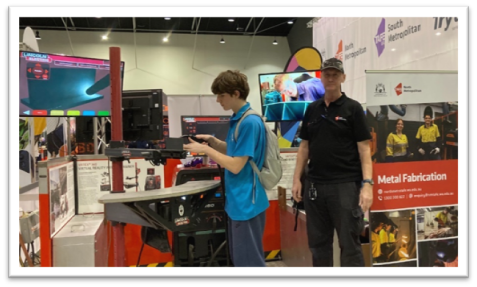
Metal Fabrication Goes High Tech

I thought metal fabrication was a hammer and a sheet of metal, not computer driven.

Metal Fabrication at North Metro TAFE

Metal Fabrication at South Metro TAFE

WorlsSkills Competition

This year it seemed easier to see the students competing in WorldSkills.

Mervyn has won GOLD at the national WorldSkills Competition. Congratulations!!

Women in Building Support

Women represent under 5% of those working in building trades.

Women Building Australia supports women trying to break into well paid jobs in building trades.

McDonalds Traineeships

McDonalds were there again promoting their traineeships and jobs for young workers. McDonalds gives great training to young staff so they are worth considering when going for part time jobs.

Jobs and Skills Career Services

North and South Metro Jobs and Skills Centres were there with a prime spot just inside the entrance. They were introducing the career advisory services to students and helping those who had time to ask for advice.

Specialist Employment Services

There were several providers of career advice and job finding services to school leavers, like impact services.

Great Work

There was almost too much to see at the Expo. With such a significant event, visitors might need to do more preparation so that they don’t miss information that meets their needs.

Subscribe to In Focus Careers News

In Focus Careers News for West Australian schools provides educators and familieis with news about emerging career opportunities in Western australia.

Posted on — Leave a comment

Year 12 Burnout Busters

Stress + Frustration = Burnout

Stress – That you STILL have to push through to the end of the year AND get the best possible results.

Frustration – That you have already been at school sooooo looong.

Trying to maintain interest when school seems more about the past and only vaguely about the future, can cause lack of motivation and have a bad impact on your academic performance.

Give school subjects meaning. Link your results to your future life.

See if you can re-engage with your school work by talking with your school based Career Advisor, (Year Coordinator, favourite teacher, pastoral care officer).

See an out of school career professional.

  • Jobs and Skills Centres are in most country towns and they are co-located with TAFE colleges in the city. Advisors can do aptitude tests, help you to identify your strengths and suggest possible future. You can find your closest Jobs and Skills Centre HERE.
  • University career advisors are a bit like sales people. They love helping people and they want you to find a course at their university. You will probably choose a uni that is close to where you live. Go to see a career counsellor at which ever university you choose to find out about courses and subjects and the fantastic clubs and opportunities available at that university.
  • See an independent, impartial professional career advisor (like me).

If you want impartial advice on the different universities in WA, get A Comprensive Guide to Going to Uni in WA in 2024. You can get it HERE.

Finding a scholarship to apply for could motivate you.

Check:

Scholarships not for you? Think again. The world wants you to succeed.

Scholarships for Academic Superstars

Try these ideas to motivate yourself over the next few weeks

  • Create SMART goals for each subject, then plan your timetable for the next few weeks. Find how to do that HERE.
  • Walk around your future uni campus and imagine yourself there (once you get through this last few weeks).
  • Go to an information evening at your future university.
  • Talk to a student already at the university for tips on how to overcome year 12 burnout.
  • You are not the first one to feel burnt out. Counselling services like Beyond Blue know how to support you.

There are many paths to university. Check Alternative Paths to Uni in 2024

Plan a Gap Year

If you can make it through to the end of the year, apply to uni like everyone else, then defer once you get your offer and take a gap year in 2024.

A comprehensive Guide to Gap Year Ideas that may interest you

Three Gap Year stories to give you ideas of what’s possible

Leave School Now

If you REALLY can’t stand it, take a break. Leave school if that is the best option for you.

Check out Alternative Paths to uni in WA 2024

I have talked to many parents who have pressured their year 12s to:

“Hang in there.”

“You are so close to the finish line. Don’t waste it.”

They are doing this because they love you and want what’s best for you. They clearly don’t understand your level of burnout.

Take time to explain your distress.

Talk with a counselling service like Beyond Blue. They will know how to help you.

There are a million paths to your best possible future and getting great end of school results is just one of them.

Don’t get on the Uni Bus unless you know where it’s going.

Year 12 can be an endurance test. Trying to link future you with what you are doing now may help. Good luck as you enter this final stage of your school career.

Subscribe to In Focus Careers News to find opportunities that help you to find where you belong.

Cover of July In Focus Careers Magazine
Posted on — Leave a comment

Alternative Paths to uni in WA 2024

All universities have developed lots of pathways to their door. The choices can be confusing.

Alternative Pathways to Uni in WA 2024  collates information on all the different pathways and provides:

  • tables of courses offered by each university

  • links to more detailed information for each pathway.

What’s good about alternative pathways?

Alternative pathways are frequently free.

As you do the course you find out about uni life and about a range of degrees that are available. You may find out about less expensive ways of doing your degree or about scholarships. 

Courses like medicine, which have strict quotas, are not available through alternative pathways, but most courses will be open to you. 

Although each course is different there are usually 4 subjects like….

  • Academic Writing

  • Research Skills and Information Literacy

  • Communication Skills

  • Essential Maths

You will meet new people, talk about courses, costs and career options with them, explore the campus and libraries and get familiar with the uni IT systems. 

How to choose a university

Pick a university that you would like to belong to. 

 Is it close? Are your friends going there? Does it have a great course? Do you like its ranking by past students? 

  • Go to that university and meet with a career advisor. Tell them what you would like to study.

  • Ask them what is available to help you to meet entry requirements. They will point you to the best course for you, or design one that meets your needs. 

Check out Which Uni is Best for You? for a quick overview of West Australian unis.

Final Tips

  • Students can calculate their anticipated ATAR HERE

  • Students can check the Lowest Offered ATAR Rank in 2023 to see if they have a chance of getting in next year.

  • If something goes wrong in Year 12, you could apply for special consideration through the TISC Access Scheme

Get your copy of Alternative Pathways to Uni in WA 2024

Posted on — Leave a comment

Are Year 12s still locked down? Time to kick start their creative magic.

Have year 12s lost their creativity? This is the group of students that was starting Year 9 when Covid hit.

Through the global pandemic teachers and families did what they could to keep students safe, to support their learning, to reduce uncertainty.

Perhaps the legendary rebellion of year 9s was knocked out of them. The world was a dangerous place and mucking up at school in year 9 seemed trivial. Now are left with year 12’s who didn’t learn to test their boundaries. Now we have year 12s who can follow instructions but they don’t know how to explore ideas.

Give them back their magic

Here are some ideas that can help students to kick start their creativity.  It’s a Mind Map of different arts projects around Western Australia that receive government subsidies.

These  are a good place for students to start if they are thinking about going into a creative career. 

If you know of any other opportunities please send them through and I will update the Mind Map.

Subscribe to In Focus Careers to help students to find where they belong.