This post contains detailed information about pathways into electrical trades in Western Australia.
Being offered an electrical apprenticeship is getting as hard as getting into medicine. At the end of 2025 hundreds of West Australian high school students missed out on electrical pre apprenticeships.
It’s not what you know, it’s who you know
It seems that the best way to get an apprenticeship as an electrician is to have a family member who is willing to employ you.
Shortage of Trainers
The resource industry is scooping up qualified electricians and paying them a bucket load to go onto the mines. It is difficult to attract qualified electricians from industry to deliver training to the 6000 apprentice electricians in WA.
Matt Shaw from Clean Energy Skills Recommendations
Matt Shaw spoke at the Career Development Conference at Curtin late last year. He told us that there is doing to be a 4% increase in demand for electricians every year to 2050.
He suggested that teachers go to the Clean Energy site for case studies and information about future careers.
From Robert Palmer at South Metro TAFE
Rob Palmer is a senior career advisor at South Metro TAFE. I contacted him for advice on how to get into a trade as an electrician from school.
Semester 2 applications via TAFE Admissions typically open in late April/early May.
The pre-apprenticeship course is also offered at Armadale as a VETDSS course for school students completing Year 11 and 12.
(These new opportunities were snapped up as soon as they became available. It may be easier to get a place in Semester 2. Bev)
Rob is an advocate for people enrolling in a skills set in a related trade first. He said that working as a trades assistant or builders’ labourer for a while would make applicants more attractive to potential employers.
The Defence Industries Pathways Program is a 12-month paid traineeship which gives trainees exposure to various sectors of the defence industry (e.g. manufacturing and engineering, computing and logistics) and includes 3 X 12-week work placements with defence industry employers.
It does not provide a direct entry into the electrical trade. However, the opportunity for DIPP participants to complete work-placements and demonstrate their work-ethic and aptitude can put them in a good position when Defence Industry employers advertise electrical apprenticeships.
Martin Turnbull at the Rockingham Jobs and Skills Centre Defence Industry Team (Martin.Turnbull@smtafe.wa.edu.au) is a good contact for the DIPP.
The College of Electrical Training is now the biggest trainer of apprentice electricians in WA. They have a maths quiz as part of the application, and the CET course and will also be highly competitive.
Apprenticeship Support Recommends
Apprenticeship Supporthas joined the challenge to find pathways into electrical trades by recommending that students start with one of these courses:
I have requested information from ECU about courses that lead to electrical careers. These might be easier to get into than apprenticeships.
I will publish that information in the In Focus Careers Newsletter.
Subscribe to In Focus Careers News
If you need to know about emerging career opportunities in WA, you need In Focus Careers News. At $35 per issue, your organisation will have all the West Australian career information it needs to share with your school community.
In 2026 – Streaming Services like Netflix will be required to make Australian programs so there will be demand for more Australian film and television creators. Details HERE.
In 2026 – Perth Film Studioswill open in Malaga and there will be demand for creative people to use the facilities.
..a world-renowned screen industry showcasing exceptional creative content and stories to the world.
The Strategy includes a workforce development plan that allocates $11.2 million over four years. There will be an additional $2 million over two years for a pilot Digital Games and Interactive Fund, which will be delivered through Screenwest.
Current University Courses
Western Australia already offers opportunities to those who want to study for careers in creative industries.
VET Courses Provide Skills and Industry Connections
If you are willing to truly engage with the courses, do a VET course. You will quickly develop skills and get contacts who will be your passport into the industry.
Students who know how to create animation and digital games or how to maximise social media will have skills that can be used across the creative industries.
If you want to work in the screen industry start now.
Sketch out a story or game idea
Get help from friends
Use the camera on your phone to create a production.
Look for competitions or take your show reel to lecturers at one of the teaching organisations and ask for help.
Good luck with your screen industry career.
Subscribe to In Focus Careers News
If you need to know about emerging career opportunities in WA, you need In Focus Careers News. At $35 per issue, your organisation will have all the West Australian career information it needs to provide expert guidance to students.
Tertiary educators are facing barriers when they try to meet the Australian Universities Accordreforms to create better credit recognition and seamless pathways from VET to uni. Establishing a collaboration framework that facilitates easy transition from VET into degrees needs to be built on an agreed regime in order to succeed.
A critical challenge to harmonisation is that tertiary providers’ data systems are not aligned, limiting collaboration, creating duplication, and making student mobility difficult.
Australia has had agreed technical standards, that include agreement on semantics. Technical stuff is the easiest standard to negotiate. Security standards will be a critical issue.
Governance
Tertiary education providers need to agree on who is responsible for what and to what standard. These decisions can be value laden and difficult to negotiate.
Legal Framework
Establishing an agreed legal framework will be tricky as VET is a State government responsibility while universities are Commonwealth. Issues about international students, copyright and privacy will need to be agreed. It is easiest to all adopt Commonwealth legal frameworks.
Business Rules
We also need agreed Business Rules. How things are managed to preserve the reputation of collaborating organisations need to be agreed. This involves egos and personal preferences and they are the most difficult issues to negotiate.
Financial Rules
If there is a standard framework then recognizing VET skills by unis will be low cost. VET providers will need to establish systems to ensure that unis don’t bare the costs involved in recognizing VET qualifications.
Summary
The Australian Government developed its first Strategy for Joined Up Government in 2003. It is a great template that could be used by those trying to develop seamless pathways. Without an agreement, transition from VET to uni will continue to be ad hoc and wasteful.
I was one of a small group of visitors invited to an early inspection of the new ECU City Campus.
It was a tour of a building site. We had to wear PPE. There is plastic protecting the carpet and cardboard taped up to protect some of the walls in high traffic areas. Workers were everywhere and tradies’ boomboxes blared from each floor.
Overall impression
So much thought has gone into this building. It is actually two buildings, joined by gangways in middle floors and the two buildings become one at the top. It reminded me of Boola Bardip. Lots of open space and connectivity. It seems to soar up and it feels spacious.
What’s missing:
Coffee Shops: It may seem trivial, but there are no coffee shops in the building. Students wanting coffee will be forced to go out of the building to interact with people in the city.
No big theatre: There is no big theatre. The Heath Ledge Theatre is only a few hundred metres away and it is envisaged that students will graduate from the smaller ECU studios into the big public theatres.
No Parking: There is no parking at the campus. Public transport is the obvious way to get there. You come out of the Perth City Bus Port just metres from the front door. The Perth train station is across Yagan Square, a couple of hundred metres away.
What’s there:
Bespoke Design The building has been designed for teaching. The theatres are designed so that lighting students or sound students or creative students are the clients, rather than an audience. Expert lecturers and students from ECU and Boorloo custodians were involved throughout the design process. The final colours inside are going to reflect the colours of West Australian wildflowers.
Dance Studio Floor The floors in the four dance studios are the best they could find from anywhere in the world. They were designed in England as were the sound panels on the ceiling of the double height rooms.
Sound. Light. Action The best architects have consulted with the best creative practitioners to ensure the sound, lighting, theatrical teaching opportunities are the best in the world.
Built on springs The building is vulnerable to vibration because it is built over the train line and bus station. It has been engineered to sit on a spring foundation like that used in earthquake zones. This will be a particular advantage for the high tech equipment in the building.
Top floor services There is no room under the building for services, so they have been located in the top floors. This seems weird, but if they had been located on lower floors they would have disrupted the flow from one section to the next, which is a feature of the building.
Design
It feels like Boola Bardip. There are lots of open spaces and many hubs where you can sit and study. There are two main buildings connected with walkways on the lower floors and joined together at the top.
Orientation: The creatives face Northbridge. Business, law and cyber security are on the city side.
The entrance: The foyer off Yagan Square welcomes you with beautiful wooden bleacher like seating for public and students. An escalator to rival that in Boola Bardip draws you up into the building. The entrance ceiling is 40 metres high (don’t hold me to that) and to your left is an LED wall where students’ work will be showcased.
Ground floor gallery. There is an art gallery on the ground floor where student art will be displayed. This is a proper gallery, open to the public. You can see into it from Yagan Square.
Piano Museum In homage to the role pianos have played in early white settlement of Western Australia, there will be a museum of old pianos on the ground floor.
Theatres: There are three theatres, all with outstanding sound proofing. The recital hall impressed me most with its beautiful wooden sound proofed and acoustically perfect walls and crafted wooden ceiling. The theatres are small with the layout focusing on teaching. The playhouse theatre has tiered seating, which will be perfect for productions for a small audience.
Learning Spaces
The library area is still a work in progress, so it was difficult to understand what it will look like. There are many open study zones throughout the building. The traditional lecture rooms are high tech, as would be expected in a future looking learning space.
Logistics
The building is handed over to ECU on 19 December and staff will move in over the Christmas break.
WAAPA courses, Business and Law, Science including some IT, and Arts and Humanities will be based at the City Campus.
Education will move from Mt Lawley to the Joondalup campus.
There will be 1000 staff working from there and the building has the capacity to support 9000 students.
The campus will commence operations at the start of the 2026 academic year.
There are no WAAPA Summer School classes.
Thanks to those who invited me. It is going to be amazing!!
Everyone is using AI to generate their first draft of AI. Ty Jones from Jobs and Skills in Geraldton reckons many are a lot better than the ones he is used to getting!!
They need to be personalised once the initial draft has been done.
Ty does a brilliant presentation on the use of AI in job applications. He really demystifies how to use it. You can email him for a copy HERE.
Career Practitioners are Change Agents
We are change agents and our role is to guide people in times of significant change.
We KNOW where to find the most current relevant information and we KNOW how to engage with people.
How to Prepare for the Future
There is already a tsunami of information to wade through.
The speed of incoming information is going to increase. My advice is to specialize if you can. Pick a narrow field and go deep if you want to keep up.
If you can’t specialize you need to form strong networks of experts to work with.
Learn How to Provide Holistic Solutions
Nora Bateson’s Warm Data methodology and Dave Snowdon’s Cynefin Framework provide ways of addressing complex environments.
Engage. Connect with people. Find out how they are coping. Go to more conferences and to more meet up meetings. We need to be sharing what we know through the lens of career professionals.
As educators we are at the start of the AI road. We are learning to delegate the teaching of data to large language models.
Digital twins technology is an example of an AI teaching tool that seems to personalise the learning experience. It can map a students’ actual learning style against an ideal model. It then creates a personalised learning program that will help the student to learn most effectively.
AI will help us to create individualize teaching of data to a class of 30 students. Students will be able to learn using their bespoke programs on their devices with little support from a teacher, once the personalised program is set up.
AI can also teach relationship between scientific facts. Hydrogen + Oxygen = Water.
It can help us to plan. We can plan how to teach a student with learning difficulties more effectively?
It can help us to prepare. I heard Tess Magden, captain of The Opal’s basketball team, saying that every team member has a personalised AI created training program.
AI creates opportunities to make teaching better.
Back to the future
We are already stuck to our screens. We text rather than talk to people. Kids no longer break their arms while playing, because they are inside playing computer games. Friendly bots are becoming our imaginary friends replacing the need for human interaction.
As our non-digital world narrows there will be increasing need for educators to consciously and deliberately teach people to engage with and solve problems with other people. Learning activities will become places for engaging with data to collaboratively generate constructive solutions, while developing mental health, community connections and peer relationships.
Educators will engage with warm data that captures relationships between systems and the consequences of decisions. A lot of data learning will be done by AI.
The future for STEM education
Teachers of STEM will have the greatest opportunities through adopting AI.
There is a lot of data to learn in STEM subjects. Using a program like digital twins to teach the periodic table and multiplication tables will release teachers from the tedium of rote teaching.
Learning to apply facts will become the more joyful role of the science teacher.
Learning to think about the application of facts will be the most challenging part of STEM teaching.
Making wise decisions about the application of STEM facts requires human capital.
So many people don’t believe that climate change is real. People don’t know who to trust and they ignore the scientific evidence delivered by experts. How do we teach people who and what to trust in a world of malicious influencers?
Tech giants want to deregulate copyright laws so that AI can use artistic works. Should we steal intellectual property and make a profit from it, just because we can?
DNA results collected by bankrupt firm 23andMe have been sold. Regeneron Pharmaceuticals now owns the data. What should they do with it?
What considerations were included in the architectural decision NOT include a coffee shop in the new City ECU building.
Introducing holistic thinking, wise decision making and the capacity to stand up for what is best for the greatest number of people, will become an increasing challenge for STEM teachers.
How to Prepare for the Future Now
Warm data is the best discipline I know to understand the relational processes between and among systems. Its creator, Nora Bateson is a genius. There are occasional Warm Data labs in Perth.
David Snowden is another systems person worth exploring. He created the Cynefin Frameworkwhich provides a description of peoples and cultures with their customs, habits and mutual differences.
Both Bateson and Snowden are tackling how to deliver holistic approaches to understanding. Twenty years ago, my lotto dream was to go to Wales and do Snowdon’s course. Now that I have learned about Warm Data, I like it better.
Snowdon and Bateson can be seen on webinars together. They have minds like planets. You can trust them as a good source of thinking when you start to consider teaching in the age of Artificial Intelligence.
Stephen Spielberg made his first feature move at 16, yet even he advised to listen for a whisper rather than wait for your dream to shout to you. You would expect the creator of the BFG, Indiana Jonesand Jurassic Parkto know he wanted to be a movie maker.
Perhaps even Speilberg had doubts about his career choice, or wondered if there was something better for him.
Charles Kingley said:
It is tricky to find a job you are enthusiastic about. Those jobs don’t shout out to you.
As career professionals it is our role to help people to:
Become Aware of opportunities for enthusiasm
Explore career pathways to happiness
Help them to engage in work they find interesting
Repeat 1 – 3 until they find something to become enthusiastic about.
Using the Model
When working with people, ask them where they want to start on this career model:
Are they looking for something totally new?
Do they know what they want, but not know how to get there?
Are they interested in their work but want to refine their target for the future?
Download this copy of the Career Influence Model to use with your clients
Leaving school is one of the biggest changes you will ever face. Change is scary and exciting.
When you leave school you can go to uni or TAFE, or you can explore your world by taking a Gap Year.
This post identifies Gap Year opportunities in:
Agriculture
Defence
Volunteering overseas
Studying overseas
Working in the outback.
AgCareerStart / Agriculture Gap Year Program
If you’re 17-25, this unique gap-year program provides you with a paid job, training and development, not to mention the opportunity to build your networks within the agriculture industry.
You can indicate which farm type you’d prefer and where in Australia you would ideally like to go. Find details HERE.
Summer School Harvest Jobs with CBH
Summer jobs with CBH are a tradition in the West Australian wheatbelt. Students work hard through the heat and dust to earn good money to travel, buy a car or fund their study.
The pay is only $33/hour but there is a load of overtime, there is training, free accommodation and a range of roles. Check details HERE.
Vacation Swimming Instructor Jobs
If you are 17 you can be a qualified swimming instructor. Check the qualifications you need HERE.
The horticulture industry relies on people to pick their fruit and veggies. If you take on this work you will probably meet backpackers who are traveling around Australia.
You can apply for a Defence Force Gap Year in the Airforce, Navy and Army.
There is a range of different job opportunities that you can apply for.
To be eligible to apply, you’ll need to be an Australian citizen aged between 18 and 24 on COMPLETION of military training. You’ll also need to have completed Year 12 (subject passes required vary by job) and have passed in Year 10 English and maths.
Applications for all roles are now open – and will close as positions are filled. Learn more HERE.
Army Reserves – part time defence jobs
If you want to do something different on a part time basis, you can apply to join the navy, army or air force reserves. There is a range of jobs you can do.
Because of skills shortages, resorts and roadhouses are importing workers from the Pacific Islands… and everywhere else!
Look for these jobs on sites like Seekor phone/email the local tourist bureau and ask where to find a job in the area.
If you are 18 you can earn more money serving alcohol than cleaning or serving in a cafe. You will need your Responsible Service of Alcohol certificateto be able to work serving alcohol.
Work on a Station
Can’t ride a motor bike or muster cattle? Maybe you can make scones or serve coffee.
Ellenbrae Station Scones
Many stations supplement their incomes through tourism.
If you can clean and make a bed, you can probably find a job supporting the station tourism industry. Look for jobs on sites like Seek.
VolunteerOpportunitiesfor school leavers
Cahoots provides camps and programs for young people with disabilities. They are looking for Year 12 school leaver volunteers who are willing to support young people to engage with recreational activities.
With projects based on the edge of the world’s best safari and close to Mount Kilimanjaro, it’s no wonder that Tanzania is one of our most popular destinations.
In Tanzania, you’ll help support Maasai communities. Consider the following options:
If you would like to study overseas, you can check out your options at hotcoursesabroad.
Crimson is a company which links Australians to university courses in the UK and US. You can get the latest information HERE.
Need Experience? Volunteer at Home
Once you leave school it is tricky getting work experience as employers aren’t insured to cover unpaid volunteers.
In Western Australia you can apply for volunteer work through Volunteering WA. People put in requests for volunteers to them and they place people and cover them through the Volunteering WA insurance.
The Volunteering WA people said that when you first start with them they are careful of the sort of work they let you do until you have proven yourself.
Youth Central provides trusted government advice on gap year opportunities
Youth Central isn’t trying to sell you anything. They don’t want anything from you. They are just trying to help.
Check out Youth Central. It’s a Victorian Government site that has clear, unbiased tips on taking a gap year.
The cost of travel and living in the city stop students from the country going to university. The Commonwealth government supports students who need to relocate to undertake further study. Find more information HERE
Country Education Foundation (CEF) helps rural and regional youth access education, training and jobs through grants, scholarships, support services and resources.
The purpose of this scholarship is to support regional students from low socioeconomic backgrounds who are experiencing financial hardship and have contributed to their local community.
Check the Curtin Alumni Regional Scholarship HERE.
Curtin Home Away From Home Scholarship is for first-year Health Sciences students from a rural background, providing $15,000 annually towards on-campus accommodation, along with pastoral care and support services These scholarships may be accessed through theCurtin Alumni & Friendsprogram or by checking specific scholarship details on the Curtin University website.
For students who need to relocate from a regional or remote area to commence an undergraduate degree at Curtin University, who are from a low socioeconomic background and are experiencing financial hardship. Find more at Harry Perkins Memorial Scholarship.
The Convocation of UWA Graduates and The University of Western Australia (‘the University’) are providing a scholarship to assist an eligible regional or remote student with the cost of accommodation at University Hall or other college affiliated with the University.
The UWA Harry Leaver Scholarship assists eligible regional or remote students, preferably from Moora or the Mid West region, with the cost of accommodation while they commence and pursue a Bachelor of Science at UWA.
The UWA Harry Leaver Scholarship provides $15,000 per annum to support accommodation fees at University Hall, and is administered and awarded by the University of Western Australia.
ECU provide scholarships which have been established specifically to assist students who normally live in a rural, regional or remote area of Western Australia, or in some cases Australia wide, who are having to relocate in order to study at University.
These include the following scholarships for undergraduate students:
High achieving regional students are encouraged to apply for a scholarship that will help them with their living costs when they move to the city to study at Murdoch University.
The George Alexander Foundation (GAF) is offering six scholarships to the value of $24,000 which successful applicants can use towards the cost of their living and accommodation expenses while in Perth.
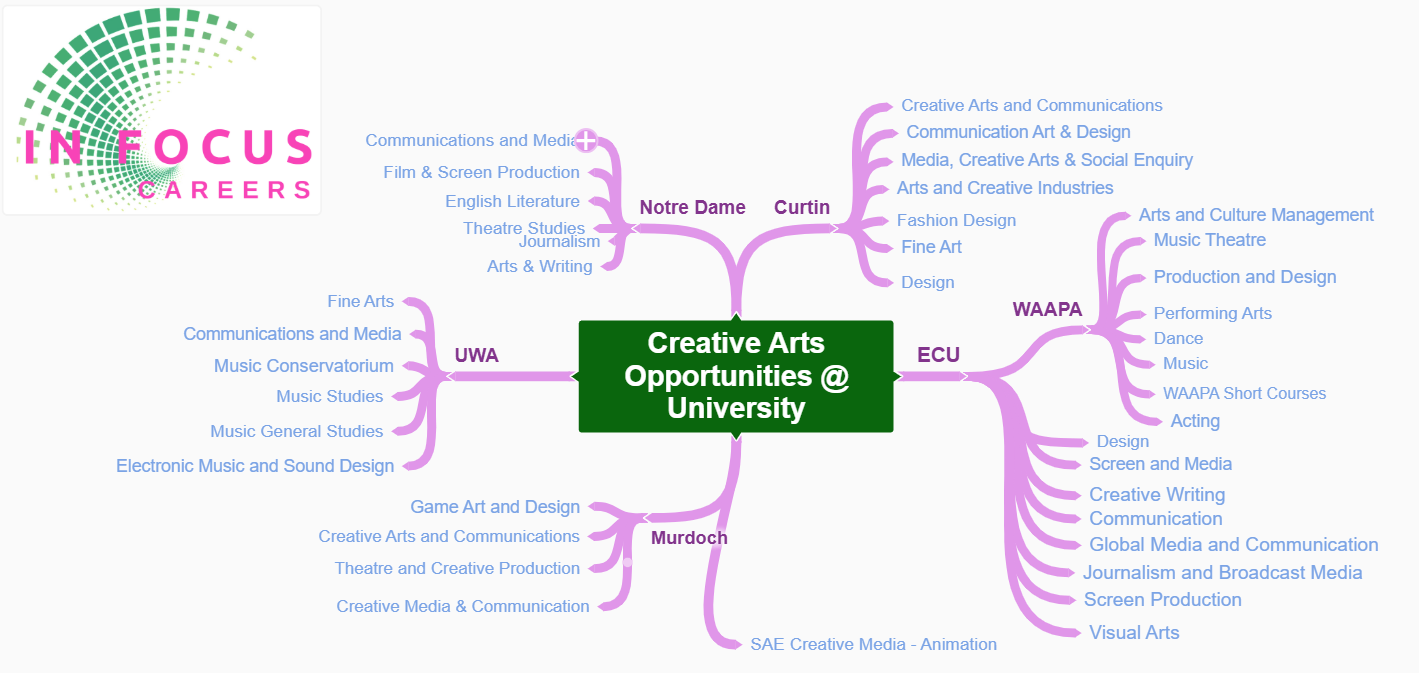

 Download Creative Arts Degree courses HERE.


 Matt Shaw spoke at the Career Development Conference at Curtin late last year. He told us that there is doing to be a 4% increase in demand for electricians every year to 2050.


 The 10 year plan aims to create: